 IVERTABS
find car insurance quotes / find auto insurance quotes: Checking the legitimacy of a quote source
Independent educational guide. Ivertabs does not issue insurance quotes or sell policies. Confirm eligibility, price and coverage with a licensed provider.
If you are searching for find car insurance quotes, the useful next step is to understand checking the legitimacy of a quote source. Related searches such as find auto insurance quotes raise the same practical questions. This guide explains the decision, the details to verify and how to read the offer before relying on it.
Checking the legitimacy of a quote source
Search advertisements, directories and insurer websites serve different roles. Verify a business through its official website and the relevant state insurance department rather than trusting a familiar-looking logo alone. A lead generator may introduce an applicant to licensed sellers without underwriting a policy itself. Knowing the role of the website makes it easier to understand who handles payment, policy documents and future claims.
A worked decision example
An applicant follows an advertisement to a page using generic insurer images but no underwriting company name. Before providing payment information, the applicant checks the organization and contacts the insurer through a verified channel. The extra step clarifies whether the page is an authorized seller, a marketing form or something else.
The figures and situations in this example are illustrative, not a personalized rate or an offer of insurance. Use the reasoning to check your own documents, and obtain actual terms from the provider. A difference in price only becomes meaningful after you know which protections and conditions changed.
Your practical checklist
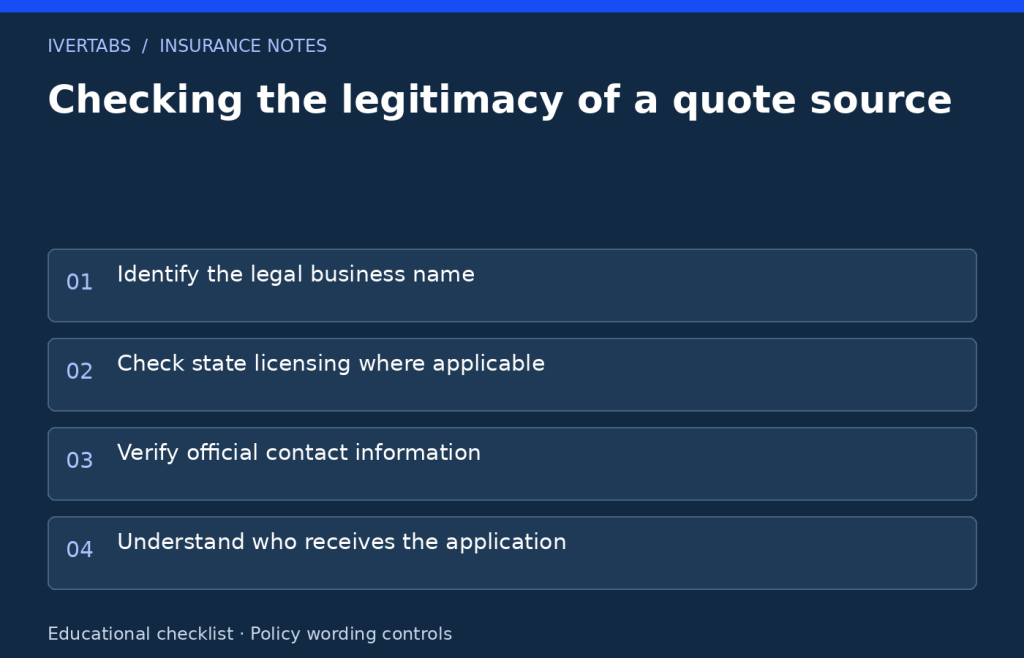
- Identify the legal business name
- Check state licensing where applicable
- Verify official contact information
- Understand who receives the application
Understand what a liability limit measures
Liability limits describe the maximum available under particular coverage provisions; they are not a general promise that every expense will be paid. A split-limit presentation such as 100/300/100 commonly expresses bodily injury per person, bodily injury per accident and property damage per accident in thousands of dollars. A combined single limit uses a different structure. Ask the seller to identify the format before comparing two offers that display unfamiliar numbers. The example is an explanation of notation, not a recommendation or a statement of your state minimum requirements.
A vehicle with a modest resale value can still be involved in an accident that causes expensive damage to another person. For that reason, choosing liability protection only from the value of your own car mixes two different exposures. State minimums establish a legal floor where applicable; they do not establish that the floor suits every household. Consider your financial situation and seek individualized guidance from a licensed professional when deciding on limits.
When recording a quote, write each limit beside its coverage name. Do not write only the package label, because labels can change between insurers and may conceal different combinations. If a seller cannot provide the same limits as another offer, record the difference and request the nearest suitable alternative. A comparison remains useful when the differences are explicit. It becomes misleading when a smaller limit is quietly treated as equivalent protection. Before accepting an offer, reconcile the limits in the quote with the issued declarations page.
Evaluate the deductible as a real cash obligation
A deductible is an amount the policyholder retains under the applicable claim provision. Collision and comprehensive can have different deductibles, and the way a deductible applies is determined by the policy. A higher deductible may produce a lower premium, but the premium difference needs to be considered beside the extra amount you would need to fund following a qualifying loss. It is a transfer of risk rather than free savings.
Suppose two otherwise comparable collision options have $500 and $1,000 deductibles, and the higher option reduces the annual premium by a hypothetical $100. A qualifying claim involving enough covered damage would leave an additional $500 with the policyholder under the higher option. Five years of that annual saving would equal the additional deductible, but that simple arithmetic does not predict when an accident will happen or guarantee that premiums stay unchanged. Use it as a way to understand the size of the tradeoff.
Check your available emergency funds before selecting the larger deductible. A deductible that is technically affordable on paper may be difficult to pay while also covering transport, rent and other immediate obligations. Keep comprehensive and collision choices separate in your worksheet. If you have a lender or lease, confirm its deductible restrictions as well. Finally, read whether any specific feature changes how the deductible applies. The accepted policy wording controls; a sales phrase such as low out-of-pocket cost does not replace that wording.
Compare the full policy cost, not one installment
Write down the policy term before comparing prices. An annual quote and a six-month quote cannot be compared by their totals alone. Annualizing a six-month premium can help with a budget estimate, but it does not guarantee the price of the next renewal. Ask whether the displayed amount includes all applicable fees and whether the selected payment plan changes the total payable.
A payment plan can include a larger first payment, multiple later installments and fees. Add those amounts explicitly. For example, a hypothetical $200 initial payment followed by five payments of $100 totals $700 over the six-month term. That is a different payment pattern from six equal installments, even if a sales screen emphasizes a similar monthly figure. Paid-in-full discounts and automatic-payment conditions should be compared using the offered terms rather than assumed to apply to every applicant.
Consider cash flow separately from total cost. A plan with a slightly higher total may be easier to manage, but missed installments can create serious coverage and billing problems. Read the due dates, methods of payment and any conditions for maintaining discounts. If you use automatic payment, confirm which account is authorized and keep the confirmation. Changing banks or replacing a card may require an update. Save both the payment schedule and policy documents so you can distinguish a billing question from a coverage question when contacting the insurer.
Treat discounts as conditional pricing features
Discounts can be tied to payment method, prior coverage, vehicle equipment, multiple policies, driver training or other factors that vary by provider and jurisdiction. A discount name does not establish that you qualify or that the same savings apply to every policy. Ask which discounts are included in the displayed quote and what documentation or continuing behavior is required to keep them.
Compare the final premium after the offered discounts rather than ranking insurers by the largest percentage advertised. A large discount applied to a higher starting price can still produce a higher final cost. If two offers are close, examine conditions that might change during the policy term or at renewal. A price that assumes an automatic-payment arrangement should be compared with an offer using the same payment preference where possible.
Some optional programs involve monitoring driving behavior through a device or mobile application. Review the consent, data use and possible pricing consequences before joining. Do not assume every program can only reduce the premium. If you decide to opt out, ask how that affects the quote. Save written details of any discount on which your decision depends, particularly a multi-policy discount. If the qualifying policy is later canceled or moved, the remaining policy cost may change. An attractive initial price is more useful when its conditions are understood and practical to maintain.
Account for verification and underwriting
An initial quote can be based on the facts entered by the applicant and remain subject to verification. The provider may request records, proof of prior coverage or clarification about vehicle use. Eligibility and price can change when the insurer receives additional information. Ask which part of the offer is preliminary and what must happen before it can be accepted.
If a revised price appears, compare the revised inputs with the original application. Look for a corrected address, driver history, mileage figure, discount assumption or coverage selection. A change is easier to assess when the reason is identified. If a record appears inaccurate, ask the insurer about the appropriate correction process and obtain the underlying information through the proper source. Do not simply enter a different answer to make the price return to the original estimate.
Keep the final accepted offer with the confirmation and policy documents. When a provider asks for supporting documents, confirm where to send them and whether a deadline applies. If the seller cannot offer the required effective date while reviewing the application, consider other valid options rather than driving with assumed protection. Underwriting is part of the actual purchase process, even when the first screen appears instantly. A clear distinction between quotation, verification and acceptance reduces confusion about both price and the moment coverage begins.
Identify the seller and underwriting company
The name on an advertisement can describe an agency, a comparison service or an insurer. Those organizations can have different responsibilities. An agent may arrange a policy underwritten by another company; a lead generator may only introduce an applicant to sellers. Ask who issues the contract, who receives payment and who handles policy service and claims. Clear answers make the transaction easier to verify.
In the United States, state insurance departments provide resources for checking licenses and learning about consumer complaint processes. Use the relevant department for the jurisdiction where the policy is sold. The existence of a license is an important verification step, but it is not a guarantee that every product is suitable for your circumstances or that every interaction will be problem-free. Combine verification with a careful review of the actual offer.
Keep the legal company name in your comparison worksheet, even when a familiar brand is prominent on the page. If multiple affiliates or partners appear, ask which one underwrites your particular offer. Do not interpret a logo on an educational article as an endorsement or affiliation. Ivertabs does not issue insurance quotes or represent the companies discussed. When contacting a provider, reach it through an official channel and confirm that a seller claiming to act on its behalf is authorized to do so.
Read the website privacy and contact permissions
Insurance applications can involve sensitive personal information. Identify the organization collecting it and the reason each field is requested. A comparison service may share information with participating insurers or agents; a direct insurer application may follow a different process. Read the privacy notice and contact-consent language before submission, particularly if you do not want follow-up calls or messages from several sellers.
A secure connection protects information in transit, but it does not prove that the business behind the page is licensed or trustworthy. Verify official contact details and the legal business name through appropriate independent sources. Be cautious if a seller requests payment through unusual channels or refuses to identify the underwriting company. Contact the insurer using a verified number or official website rather than relying entirely on a link sent by an unknown person.
Avoid sending unnecessary personal documents with general questions. A coverage question can often be asked without sharing a full driver license, complete account number or detailed medical information. When documents are genuinely needed, ask for the verified upload process and what parts of the document are required. Keep a private record of consent and communication preferences. If you receive unexpected partner contact after using a comparison form, review the permissions you accepted and use the organization stated process to request a change. Privacy practices differ, so judge the actual notice rather than assuming all quote sites work alike.
Know which document answers which question
A quote summary describes a proposed price and selected coverages. A receipt records a payment. A declarations page summarizes the issued policy, while the policy form and endorsements contain terms that affect how protection applies. An insurance card supplies selected evidence of coverage, and a binder may establish temporary coverage under its own terms. These documents are related, but they are not interchangeable.
When you buy, reconcile the insured names, VINs, drivers, limits, deductibles and dates on the issued documents with the final offer you accepted. If something differs, contact the insurer promptly and keep the corrected version. An omitted lender or incorrect vehicle identification can create problems even when the premium looks right. Ask whether outstanding documents or corrections affect the accepted coverage or only administrative details.
Store the documents securely and make the service and claims contacts easy to find. A useful folder contains the final offer, payment schedule, declarations, policy form, endorsements and relevant written explanations. Avoid publishing personal documents in a public review or forum. If you later shop for replacement coverage, the declarations page becomes an efficient reference specification, while the full policy helps explain important limitations. Reading the paperwork before an incident gives you a chance to resolve ambiguity when there is still time to make an informed choice.
Frequently asked questions
Does a professional-looking website prove licensing?
No. Verify the business through independent official channels and identify the insurer responsible for the policy.
Which details should I keep with the offer?
Keep the written coverage specification, final price, policy term, effective date and payment plan. Retain the provider answers to the checklist questions above. If a document changes after verification, use the latest accepted version and ask what changed before completing the purchase.
Can this article confirm my coverage?
No. An educational explanation cannot determine your eligibility or bind insurance. The issued contract, accepted application and relevant law determine the protection available. Ask the provider to explain any unclear condition in writing, particularly if your vehicle use, financing or household situation differs from the example.
Official reading and next steps
Use official resources to check current provider information and jurisdiction-specific requirements. Then request an offer using accurate facts and the coverage specification you intend to purchase. Review the final documents before relying on the policy.
Related guides
- auto policy quotes / shop auto insurance rates / shop car insurance rates: Separating premiums from payment schedules
- shop for car insurance / shop car insurance quotes / shop around for car insurance: Building a repeatable shopping process
- get multiple car insurance quotes / multiple car insurance quotes at once / compare multiple car insurance quotes: Understanding comparison sites and market coverage