 IVERTABS
auto insurance online purchase / buy vehicle insurance online / buy motor insurance online: Recognizing regional insurance terminology
Independent educational guide. Ivertabs does not issue insurance quotes or sell policies. Confirm eligibility, price and coverage with a licensed provider.
If you are searching for auto insurance online purchase, the useful next step is to understand recognizing regional insurance terminology. Related searches such as buy vehicle insurance online, buy motor insurance online raise the same practical questions. This guide explains the decision, the details to verify and how to read the offer before relying on it.
Recognizing regional insurance terminology
Vehicle, motor and auto insurance terminology varies by market. A page written for United States personal auto insurance may not describe a contract sold in another country. Even familiar words can have different legal meanings, policy structures or mandatory protections. Identify the country and state or region where the vehicle is registered and used before comparing products. A cross-border search result should not replace locally appropriate provider information.
A worked decision example
A reader searches for motor insurance and finds a foreign website quoting prices in another currency. The product may be genuine for its own market, but that does not establish that it satisfies the reader local vehicle-registration requirements. The reader checks locally licensed providers and confirms which geographic territory the policy covers.
The figures and situations in this example are illustrative, not a personalized rate or an offer of insurance. Use the reasoning to check your own documents, and obtain actual terms from the provider. A difference in price only becomes meaningful after you know which protections and conditions changed.
Your practical checklist
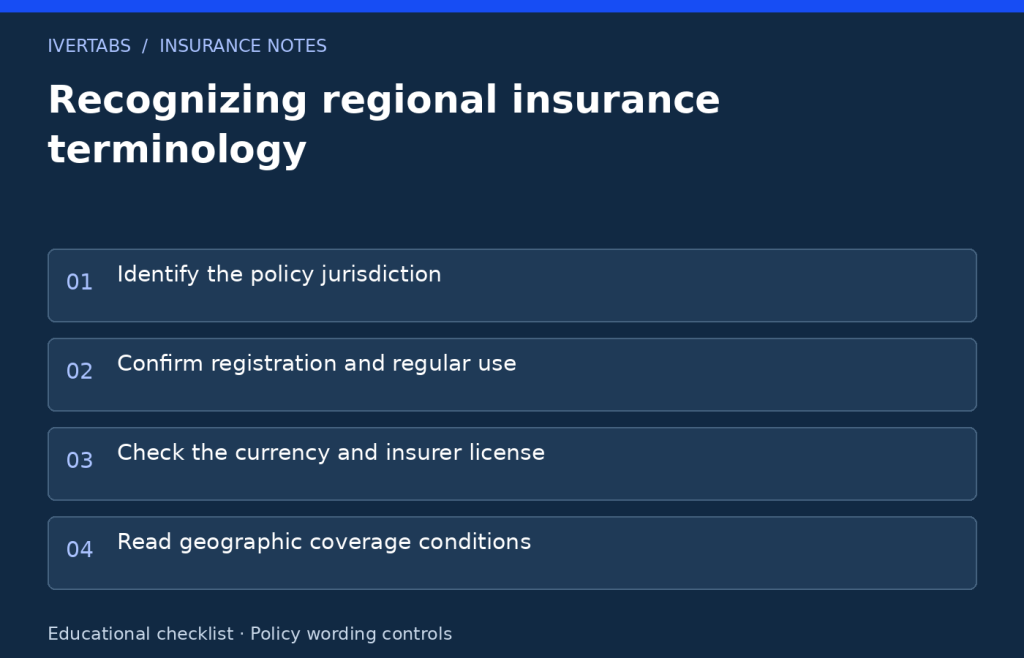
- Identify the policy jurisdiction
- Confirm registration and regular use
- Check the currency and insurer license
- Read geographic coverage conditions
Read the website privacy and contact permissions
Insurance applications can involve sensitive personal information. Identify the organization collecting it and the reason each field is requested. A comparison service may share information with participating insurers or agents; a direct insurer application may follow a different process. Read the privacy notice and contact-consent language before submission, particularly if you do not want follow-up calls or messages from several sellers.
A secure connection protects information in transit, but it does not prove that the business behind the page is licensed or trustworthy. Verify official contact details and the legal business name through appropriate independent sources. Be cautious if a seller requests payment through unusual channels or refuses to identify the underwriting company. Contact the insurer using a verified number or official website rather than relying entirely on a link sent by an unknown person.
Avoid sending unnecessary personal documents with general questions. A coverage question can often be asked without sharing a full driver license, complete account number or detailed medical information. When documents are genuinely needed, ask for the verified upload process and what parts of the document are required. Keep a private record of consent and communication preferences. If you receive unexpected partner contact after using a comparison form, review the permissions you accepted and use the organization stated process to request a change. Privacy practices differ, so judge the actual notice rather than assuming all quote sites work alike.
Account for verification and underwriting
An initial quote can be based on the facts entered by the applicant and remain subject to verification. The provider may request records, proof of prior coverage or clarification about vehicle use. Eligibility and price can change when the insurer receives additional information. Ask which part of the offer is preliminary and what must happen before it can be accepted.
If a revised price appears, compare the revised inputs with the original application. Look for a corrected address, driver history, mileage figure, discount assumption or coverage selection. A change is easier to assess when the reason is identified. If a record appears inaccurate, ask the insurer about the appropriate correction process and obtain the underlying information through the proper source. Do not simply enter a different answer to make the price return to the original estimate.
Keep the final accepted offer with the confirmation and policy documents. When a provider asks for supporting documents, confirm where to send them and whether a deadline applies. If the seller cannot offer the required effective date while reviewing the application, consider other valid options rather than driving with assumed protection. Underwriting is part of the actual purchase process, even when the first screen appears instantly. A clear distinction between quotation, verification and acceptance reduces confusion about both price and the moment coverage begins.
Confirm when accepted coverage actually begins
A submitted application, a displayed quote and an accepted policy are different stages. Do not assume that insurance begins when you open the website or click the first payment button. The provider-issued policy or binder states the relevant effective date and time, and acceptance can depend on underwriting and payment conditions. If you need coverage for a specific journey or vehicle handover, tell the seller the required start time directly.
Read the confirmation for the correct vehicle, insured name and coverage dates. If the timestamp or time zone is unclear, ask the insurer to explain it before relying on the policy. A future effective date can be appropriate for a planned purchase but unsuitable for a car you intend to drive immediately. Coverage generally should not be assumed to apply retroactively to an event that happened before inception. A fast purchase cannot change the timing of an earlier loss.
Keep the insurer-issued evidence available in the format needed by the dealership, lender or relevant authority. A payment receipt may not contain the policy information that another party requires. If there is an unresolved document request, find out whether the insurer has accepted the coverage or is still evaluating the application. For a replacement policy, coordinate the start with the old policy ending time. This avoids treating two calendar dates as equivalent when their actual coverage times leave a gap.
Know which document answers which question
A quote summary describes a proposed price and selected coverages. A receipt records a payment. A declarations page summarizes the issued policy, while the policy form and endorsements contain terms that affect how protection applies. An insurance card supplies selected evidence of coverage, and a binder may establish temporary coverage under its own terms. These documents are related, but they are not interchangeable.
When you buy, reconcile the insured names, VINs, drivers, limits, deductibles and dates on the issued documents with the final offer you accepted. If something differs, contact the insurer promptly and keep the corrected version. An omitted lender or incorrect vehicle identification can create problems even when the premium looks right. Ask whether outstanding documents or corrections affect the accepted coverage or only administrative details.
Store the documents securely and make the service and claims contacts easy to find. A useful folder contains the final offer, payment schedule, declarations, policy form, endorsements and relevant written explanations. Avoid publishing personal documents in a public review or forum. If you later shop for replacement coverage, the declarations page becomes an efficient reference specification, while the full policy helps explain important limitations. Reading the paperwork before an incident gives you a chance to resolve ambiguity when there is still time to make an informed choice.
Compare the full policy cost, not one installment
Write down the policy term before comparing prices. An annual quote and a six-month quote cannot be compared by their totals alone. Annualizing a six-month premium can help with a budget estimate, but it does not guarantee the price of the next renewal. Ask whether the displayed amount includes all applicable fees and whether the selected payment plan changes the total payable.
A payment plan can include a larger first payment, multiple later installments and fees. Add those amounts explicitly. For example, a hypothetical $200 initial payment followed by five payments of $100 totals $700 over the six-month term. That is a different payment pattern from six equal installments, even if a sales screen emphasizes a similar monthly figure. Paid-in-full discounts and automatic-payment conditions should be compared using the offered terms rather than assumed to apply to every applicant.
Consider cash flow separately from total cost. A plan with a slightly higher total may be easier to manage, but missed installments can create serious coverage and billing problems. Read the due dates, methods of payment and any conditions for maintaining discounts. If you use automatic payment, confirm which account is authorized and keep the confirmation. Changing banks or replacing a card may require an update. Save both the payment schedule and policy documents so you can distinguish a billing question from a coverage question when contacting the insurer.
Separate protection for your car from liability
Collision and comprehensive address different kinds of damage to the insured vehicle. Collision generally concerns covered damage involving an impact with another vehicle or object, or an overturn, subject to the contract. Comprehensive generally addresses covered losses other than collision, such as theft or certain weather events. Neither label means that every conceivable problem with the vehicle is covered. Wear, mechanical failure and maintenance have their own treatment and should not be assumed to be insured losses.
Compare physical-damage coverages individually. A liability-only quote can look dramatically less expensive than a quote that includes collision and comprehensive, but the difference partly reflects the protections being purchased. If the vehicle is financed or leased, your agreement may require physical-damage coverage. An insurer offering a lower-cost policy does not automatically change those lender obligations. Review the financing documents and ask the seller to quote the required protections.
For a car you own outright, consider its value, the cost of premiums and deductibles, and how you would manage without it after a loss. Actual cash value and replacement-related benefits are different concepts; do not assume that an ordinary physical-damage policy pays the cost of a brand-new replacement. Ask how the vehicle would be valued and whether optional features apply. A quote that explicitly addresses those questions is more useful than one selected from a broad full-coverage label. Record the chosen coverage lines so you can verify them when the policy is issued.
Check lender and lease requirements separately
A loan or lease can require coverage beyond the legal minimum for driving. Physical-damage protection and restrictions on deductibles may be part of the finance agreement. The lender may also need to be identified correctly on the policy documents. Review the agreement before selecting an offer, because an insurer willing to sell a particular package does not establish that the package satisfies the lender.
Vehicle damage coverage and the remaining loan balance are different financial concepts. If the car is declared a total loss, ordinary settlement terms may not equal the amount still owed. Gap-related protection can address a defined difference under specific conditions, but products differ in exclusions, eligibility and limits. Ask how any optional product works with the existing auto policy rather than assuming that the word gap guarantees payment of every outstanding obligation.
Before vehicle delivery, find out what proof the dealer or lender requires and arrange coverage with a suitable start time. After purchase, check the lender name and VIN on the issued documents. If you pay off the loan later, you can review coverage choices based on the changed obligations, while still considering your ability to repair or replace the car. Maintain written confirmation when a financing requirement is unclear. It is easier to resolve the issue before payment than after a lender rejects the evidence or requests a corrective policy change.
Evaluate the deductible as a real cash obligation
A deductible is an amount the policyholder retains under the applicable claim provision. Collision and comprehensive can have different deductibles, and the way a deductible applies is determined by the policy. A higher deductible may produce a lower premium, but the premium difference needs to be considered beside the extra amount you would need to fund following a qualifying loss. It is a transfer of risk rather than free savings.
Suppose two otherwise comparable collision options have $500 and $1,000 deductibles, and the higher option reduces the annual premium by a hypothetical $100. A qualifying claim involving enough covered damage would leave an additional $500 with the policyholder under the higher option. Five years of that annual saving would equal the additional deductible, but that simple arithmetic does not predict when an accident will happen or guarantee that premiums stay unchanged. Use it as a way to understand the size of the tradeoff.
Check your available emergency funds before selecting the larger deductible. A deductible that is technically affordable on paper may be difficult to pay while also covering transport, rent and other immediate obligations. Keep comprehensive and collision choices separate in your worksheet. If you have a lender or lease, confirm its deductible restrictions as well. Finally, read whether any specific feature changes how the deductible applies. The accepted policy wording controls; a sales phrase such as low out-of-pocket cost does not replace that wording.
Frequently asked questions
Are motor and auto policies identical everywhere?
No. Similar labels can refer to products governed by different laws and wording. Compare policies within the relevant jurisdiction.
Which details should I keep with the offer?
Keep the written coverage specification, final price, policy term, effective date and payment plan. Retain the provider answers to the checklist questions above. If a document changes after verification, use the latest accepted version and ask what changed before completing the purchase.
Can this article confirm my coverage?
No. An educational explanation cannot determine your eligibility or bind insurance. The issued contract, accepted application and relevant law determine the protection available. Ask the provider to explain any unclear condition in writing, particularly if your vehicle use, financing or household situation differs from the example.
Official reading and next steps
Use official resources to check current provider information and jurisdiction-specific requirements. Then request an offer using accurate facts and the coverage specification you intend to purchase. Review the final documents before relying on the policy.
Related guides
- new car insurance online / get car insurance now / get car insurance today: Insuring a newly purchased vehicle before delivery
- buy car policy online / car policy online / online car insurance policy: Reading a policy before buying it
- auto insurance online today / get car insurance online / get car insurance online now: Moving from an online estimate to an issued policy