 IVERTABS
direct auto quote / direct general insurance quote / direct auto insurance quote: Confirming the insurer behind a direct quote
Independent educational guide. Ivertabs does not issue insurance quotes or sell policies. Confirm eligibility, price and coverage with a licensed provider.
If you are searching for direct auto quote, the useful next step is to understand confirming the insurer behind a direct quote. Related searches such as direct general insurance quote, direct auto insurance quote raise the same practical questions. This guide explains the decision, the details to verify and how to read the offer before relying on it.
Confirming the insurer behind a direct quote
Direct can describe a distribution channel or form part of an insurer brand. Those meanings are different. A direct purchase normally means dealing with an insurer without an independent intermediary, while a search containing Direct General may refer to a particular company. Neither meaning establishes that a search result is the official site. Check the legal underwriting company, state licensing and contact details before entering a driver license or making a payment. An insurance agency may sell a policy underwritten by another company; the company responsible for claims matters more than the marketing name.
A worked decision example
A driver receives a six-month estimate of $720 from a branded page and $760 from an independent agency. The first estimate excludes rental reimbursement and uses a higher collision deductible. Before choosing the apparently cheaper quote, the driver asks both sellers to price the same limits, deductible and optional benefits. The agency explains the underwriting company separately from the agency name.
The figures and situations in this example are illustrative, not a personalized rate or an offer of insurance. Use the reasoning to check your own documents, and obtain actual terms from the provider. A difference in price only becomes meaningful after you know which protections and conditions changed.
Your practical checklist
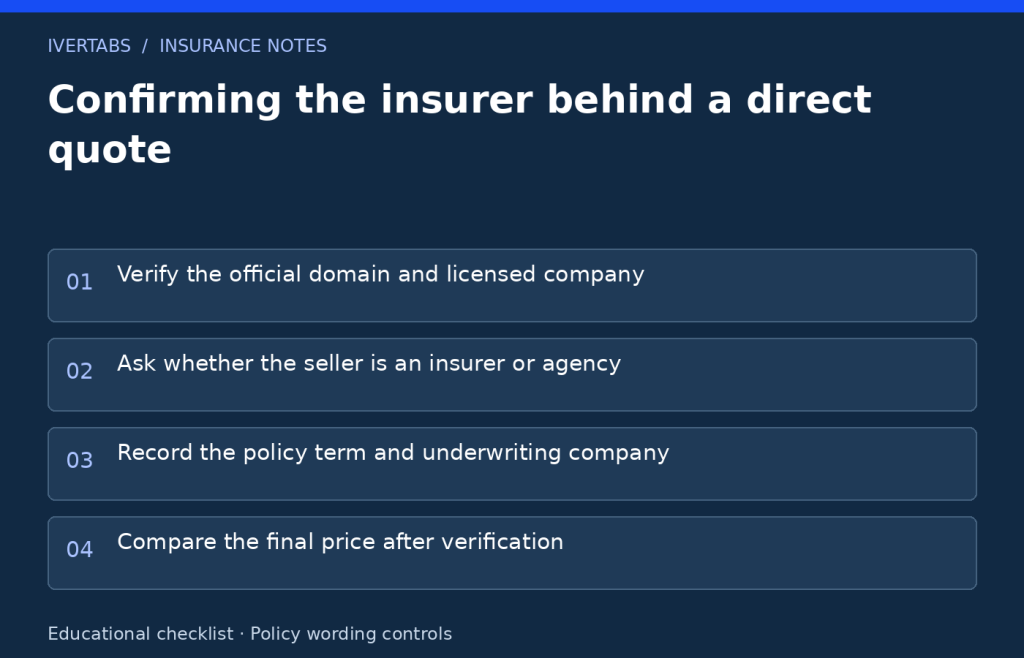
- Verify the official domain and licensed company
- Ask whether the seller is an insurer or agency
- Record the policy term and underwriting company
- Compare the final price after verification
Identify the seller and underwriting company
The name on an advertisement can describe an agency, a comparison service or an insurer. Those organizations can have different responsibilities. An agent may arrange a policy underwritten by another company; a lead generator may only introduce an applicant to sellers. Ask who issues the contract, who receives payment and who handles policy service and claims. Clear answers make the transaction easier to verify.
In the United States, state insurance departments provide resources for checking licenses and learning about consumer complaint processes. Use the relevant department for the jurisdiction where the policy is sold. The existence of a license is an important verification step, but it is not a guarantee that every product is suitable for your circumstances or that every interaction will be problem-free. Combine verification with a careful review of the actual offer.
Keep the legal company name in your comparison worksheet, even when a familiar brand is prominent on the page. If multiple affiliates or partners appear, ask which one underwrites your particular offer. Do not interpret a logo on an educational article as an endorsement or affiliation. Ivertabs does not issue insurance quotes or represent the companies discussed. When contacting a provider, reach it through an official channel and confirm that a seller claiming to act on its behalf is authorized to do so.
Understand the reach of a comparison service
A comparison website can be a helpful starting point without representing the entire market. Providers decide how they distribute policies, and some do not participate in a particular service. Read which insurers or agents appear and whether the result is an actual quote, a preliminary estimate or a request for someone to contact you. These workflows have different implications for both the comparison and your privacy preferences.
Consider collecting a direct offer from a provider absent from the comparison panel if it suits your situation. That additional offer should use the same coverage specification. A wider selection is helpful only when the offers remain understandable and comparable. Ten prices based on different limits are less useful than a smaller group with the same protections and transparent payment terms.
When a service ranks an offer as best, ask what the ranking measures. It may prioritize price, a particular feature or an internal presentation rule rather than the household needs you identified. If compensation or sponsorship affects the presentation, the disclosure should be considered. Do not assume that the first result is an independent recommendation. Keep the underlying insurer identity and policy terms in your worksheet so you can review the offer outside the comparison interface. The goal is an informed choice among suitable policies, not loyalty to one search form or a guarantee that one service finds the lowest price for every driver.
Create an apples-to-apples comparison
Start with one written coverage specification that includes drivers, vehicles, regular use, limits, deductibles and the desired start date. Give that specification to each seller. If a provider cannot match a feature, mark it as a difference rather than treating its premium as directly comparable. A consistent baseline is especially useful when websites offer preset packages that use different default protections.
Build a worksheet with separate columns for the policy term, final premium, payment fees, liability limits, collision deductible, comprehensive deductible and optional features you care about. Include the date of each offer and whether the insurer has verified the application. A preliminary estimate based on incomplete information should not be ranked as though it were an accepted contract. Follow up on missing fields before making the final decision.
It is reasonable for providers to price the same specification differently. The worksheet does not eliminate those differences; it helps you understand them. When a quote looks unexpectedly low, check for omitted drivers, a changed deductible, a different payment plan or an excluded coverage before celebrating the saving. When a quote looks high, ask whether it contains protections you did not request. The most useful result is a short list of understandable offers, each with the protections and total costs visible. That gives you a defensible basis for choosing rather than relying on a promotional headline.
Build an accurate application file
Collect the vehicle identification number, year and model, regular garaging address and the information requested for each driver. Use records you can verify rather than guessing facts to keep a form moving. Household drivers, annual mileage, commuting and business activities may be relevant to the application. An insurer can explain who must be disclosed and how occasional drivers are treated. A mailing address should not be substituted for a garaging address when those locations differ.
A useful preparation method is to create a private worksheet and keep it with your current declarations page. Record the coverage specification you want to compare, the desired effective date and any lender information. Do not post that worksheet publicly or email sensitive identifiers to an unverified address. Ivertabs does not need your driver license, payment details or VIN to provide educational articles. Share required application data only through a verified seller and an appropriate secure channel.
When a question is unclear, ask what the insurer means. For example, annual mileage should reflect your anticipated use, and the categories for business use may differ between providers. An accurate answer can lead to a different price from an initial guess, but the quote then describes the real exposure. Keep a record of corrections and requests for supporting documents. Before payment, review the final summary again. Consistency across applications improves the comparison, while accuracy protects the usefulness of the eventual contract.
Account for verification and underwriting
An initial quote can be based on the facts entered by the applicant and remain subject to verification. The provider may request records, proof of prior coverage or clarification about vehicle use. Eligibility and price can change when the insurer receives additional information. Ask which part of the offer is preliminary and what must happen before it can be accepted.
If a revised price appears, compare the revised inputs with the original application. Look for a corrected address, driver history, mileage figure, discount assumption or coverage selection. A change is easier to assess when the reason is identified. If a record appears inaccurate, ask the insurer about the appropriate correction process and obtain the underlying information through the proper source. Do not simply enter a different answer to make the price return to the original estimate.
Keep the final accepted offer with the confirmation and policy documents. When a provider asks for supporting documents, confirm where to send them and whether a deadline applies. If the seller cannot offer the required effective date while reviewing the application, consider other valid options rather than driving with assumed protection. Underwriting is part of the actual purchase process, even when the first screen appears instantly. A clear distinction between quotation, verification and acceptance reduces confusion about both price and the moment coverage begins.
Compare the full policy cost, not one installment
Write down the policy term before comparing prices. An annual quote and a six-month quote cannot be compared by their totals alone. Annualizing a six-month premium can help with a budget estimate, but it does not guarantee the price of the next renewal. Ask whether the displayed amount includes all applicable fees and whether the selected payment plan changes the total payable.
A payment plan can include a larger first payment, multiple later installments and fees. Add those amounts explicitly. For example, a hypothetical $200 initial payment followed by five payments of $100 totals $700 over the six-month term. That is a different payment pattern from six equal installments, even if a sales screen emphasizes a similar monthly figure. Paid-in-full discounts and automatic-payment conditions should be compared using the offered terms rather than assumed to apply to every applicant.
Consider cash flow separately from total cost. A plan with a slightly higher total may be easier to manage, but missed installments can create serious coverage and billing problems. Read the due dates, methods of payment and any conditions for maintaining discounts. If you use automatic payment, confirm which account is authorized and keep the confirmation. Changing banks or replacing a card may require an update. Save both the payment schedule and policy documents so you can distinguish a billing question from a coverage question when contacting the insurer.
Know which document answers which question
A quote summary describes a proposed price and selected coverages. A receipt records a payment. A declarations page summarizes the issued policy, while the policy form and endorsements contain terms that affect how protection applies. An insurance card supplies selected evidence of coverage, and a binder may establish temporary coverage under its own terms. These documents are related, but they are not interchangeable.
When you buy, reconcile the insured names, VINs, drivers, limits, deductibles and dates on the issued documents with the final offer you accepted. If something differs, contact the insurer promptly and keep the corrected version. An omitted lender or incorrect vehicle identification can create problems even when the premium looks right. Ask whether outstanding documents or corrections affect the accepted coverage or only administrative details.
Store the documents securely and make the service and claims contacts easy to find. A useful folder contains the final offer, payment schedule, declarations, policy form, endorsements and relevant written explanations. Avoid publishing personal documents in a public review or forum. If you later shop for replacement coverage, the declarations page becomes an efficient reference specification, while the full policy helps explain important limitations. Reading the paperwork before an incident gives you a chance to resolve ambiguity when there is still time to make an informed choice.
Read the website privacy and contact permissions
Insurance applications can involve sensitive personal information. Identify the organization collecting it and the reason each field is requested. A comparison service may share information with participating insurers or agents; a direct insurer application may follow a different process. Read the privacy notice and contact-consent language before submission, particularly if you do not want follow-up calls or messages from several sellers.
A secure connection protects information in transit, but it does not prove that the business behind the page is licensed or trustworthy. Verify official contact details and the legal business name through appropriate independent sources. Be cautious if a seller requests payment through unusual channels or refuses to identify the underwriting company. Contact the insurer using a verified number or official website rather than relying entirely on a link sent by an unknown person.
Avoid sending unnecessary personal documents with general questions. A coverage question can often be asked without sharing a full driver license, complete account number or detailed medical information. When documents are genuinely needed, ask for the verified upload process and what parts of the document are required. Keep a private record of consent and communication preferences. If you receive unexpected partner contact after using a comparison form, review the permissions you accepted and use the organization stated process to request a change. Privacy practices differ, so judge the actual notice rather than assuming all quote sites work alike.
Frequently asked questions
Does a direct quote always avoid fees?
No. Distribution channel alone does not establish the fee schedule. Ask for an itemized premium, installment charges and any agency fees that apply.
Which details should I keep with the offer?
Keep the written coverage specification, final price, policy term, effective date and payment plan. Retain the provider answers to the checklist questions above. If a document changes after verification, use the latest accepted version and ask what changed before completing the purchase.
Can this article confirm my coverage?
No. An educational explanation cannot determine your eligibility or bind insurance. The issued contract, accepted application and relevant law determine the protection available. Ask the provider to explain any unclear condition in writing, particularly if your vehicle use, financing or household situation differs from the example.
Official reading and next steps
Use official resources to check current provider information and jurisdiction-specific requirements. Then request an offer using accurate facts and the coverage specification you intend to purchase. Review the final documents before relying on the policy.